Personal AI agents compared: OpenClaw, Hermes, Claude Duet and Perplexity
Choose the operating model first
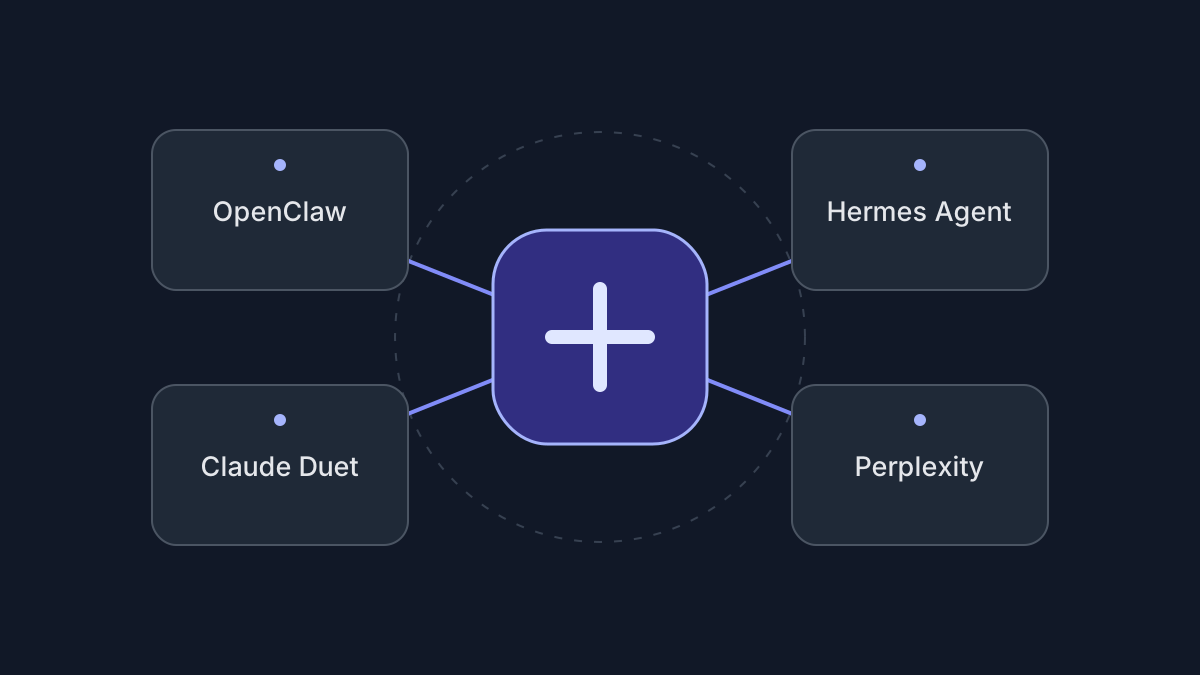
Choose the agent you can access and keep running, then test one repeatable task. These four products cover different operating models: a messaging gateway, a self-hosted agent with skills, a hosted proactive assistant, and a desktop agent. A feature list alone cannot tell you which completes your work reliably.
This comparison reflects official documentation reviewed on October 23, 2026. It is not a benchmark, and we did not run the same task in all four products.
For a direct comparison of three hosted agents, see OpenAI Dots vs Grok Bot vs Claude Duet.
Four practical starting points
| Product | Where work runs | Access to check | What you manage |
|---|---|---|---|
| OpenClaw | Your gateway host; inference depends on provider | Install and model authentication | Host, channels, tools, workspace and automations |
| Hermes Agent | Your runtime; remote or compatible local model | Installation and working model route | Profiles, bounded memory, skills and gateway |
| Claude Duet | Anthropic cloud computer | US Pro/Max and waitlist invitation | Connected apps, approvals and shared usage |
| Perplexity Personal Computer | Mac, with hybrid or supported local execution | OS, hardware, subscription and chosen mode | Folders, native-app permissions and usage |
OpenClaw's personal assistant setup centers on channels and an always-available gateway. Hermes documents persistent memory and reusable skills. Neither being self-hosted nor being open source proves that model inference stays on your machine: inspect the configured provider.
Duet's research preview conditions currently exclude Team and Enterprise and require an invitation. Do not buy a subscription solely assuming immediate access. Perplexity's October local-mode announcement lists supported Apple silicon Macs, Pro/Max/Enterprise access and a recommendation of at least 36 GB memory for fully local work. Hybrid execution is a different path; online tools can still contact external services.
A useful first task
Use three short notes you wrote yourself. Put them in a test folder for desktop or self-hosted tools, or in a deliberately connected document source for a hosted agent. Keep the content identical:
- Note A: the River draft is due October 28.
- Note B, dated later: the draft moved to October 30.
- Note C: the review meeting date has not been confirmed.
Ask for three action items with a source for each, recognition of the changed deadline, and an explicit unknown for the meeting. Request a draft only. The expected facts are October 30 for the draft and an unresolved review date. Reject an invented meeting date even if the prose looks polished.
Then ask it to remember a harmless preference, such as three-bullet summaries. Start a new session and check the saved preference separately from retrieval of the notes. A continuing chat is not a cross-session memory test. For Hermes, use our memory and scheduling walkthrough.
Record completion, source accuracy, unwanted edits, elapsed time and account usage. These are proposed acceptance criteria, not results from our testing. Run the same case again after changing the model or permissions.
Estimate ongoing costs before scheduling
For a self-hosted setup, budget model inference + paid tools + hosting + storage, with your setup and maintenance time separate. MIT-licensed software does not include an API allowance. A local model replaces provider inference charges with hardware requirements and operating costs; it does not make every connected service free.
For hosted products, check subscription + included usage + overage or credits. Duet background checks consume the same allowance as other Claude work. Perplexity's credit rules distinguish paid Consumer Pro weekly included usage from credits and promotional accounts. Check the actual Usage page and auto-refill setting.
Use an observed small-task cost as your baseline. For example, two runs each day for 30 days means 60 executions: multiply by your measured per-run consumption, then separately allow for monitoring, retries and larger inputs. This arithmetic is a planning example, not a product price or guarantee. Shared subscription limits cannot be converted into a universal cost per task.
Enable ongoing work in stages
- Finish the copied-note task interactively and inspect sources and writes.
- Confirm the correct profile, model, execution location and saved state.
- Create one paused recurring job or disabled automation; check time zone, frequency, destination and spending controls before enabling it.
- Review the first execution and the delivered result separately. Keep an explicit way to pause the job and stop its host or connection.
For a gateway-based messaging assistant, start with OpenClaw. For workflows you want to package into reviewed skills, inspect Hermes. For managed proactive work, evaluate Duet if eligible. For existing Mac files and native applications, evaluate Perplexity's execution modes. These are starting-point recommendations based on documented architecture, not quality rankings.